
Commercial & Contracts
Is a No Refund Policy Legal in Malaysia for Unused Packages?
Written by Justin Yap, Partner
Last reviewed 1 July 2026 · 6 min read
On this page
A "no refund" or "no cancellation" policy is not always valid in Malaysia. If the contract is a future services contract under section 17 of the Consumer Protection Act 1999, the business may only charge limited amounts when the consumer cancels.
This is especially relevant to service packages paid in advance. Common examples include gym memberships, beauty or slimming packages, spa packages, tuition classes, language classes, or other services that are meant to be provided over time.
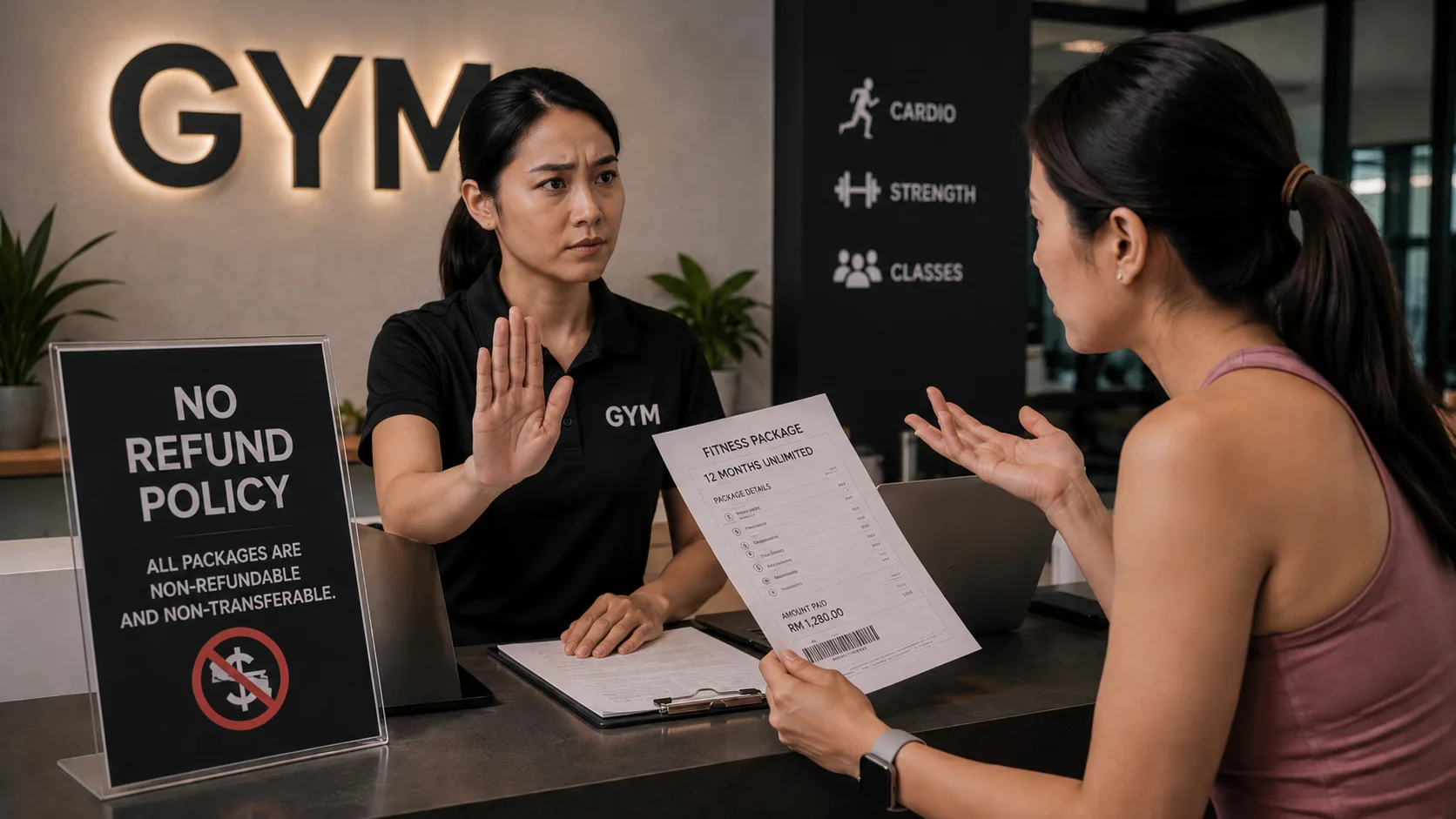
Many consumers sign up for a package, use only part of it, and later ask for a refund. The business then points to the terms and conditions and says: "No refund. No cancellation. Company policy."
That may not be the end of the matter.
If the law applies, a business cannot simply rely on fine print to keep the full payment for services that have not been used.
What is a future services contract?
A future services contract is a contract for consumer services that will be provided on a continuing basis and prescribed by the Minister from time to time.
In practical terms, it usually refers to a package where the consumer pays for services that will be used later or over a period of time.
For example, a customer may buy 20 beauty treatment sessions, a 12-month gym membership, a slimming programme, or a tuition package. The customer has paid for future sessions or future access. The service has not been fully provided at the time payment is made.
That is different from buying a one-off item from a shop. It is also different from a service that has already been fully completed.
The key point is simple. If the consumer paid for future services and later cancels, the business may not be allowed to keep everything.
What can the business charge if you cancel?
Under section 17 of the Consumer Protection Act 1999, a consumer who cancels a future services contract may be charged only the following amounts.
First, the business may charge 5% of the full contract price.
Second, the business may charge the cost of any goods the consumer has used or is keeping. This may include physical products, kits, supplements, materials, or other goods supplied as part of the package.
Third, the business may charge the portion of the full contract price representing services already received by the consumer.
The balance should be refunded if the consumer has paid more than what the business is legally entitled to keep.
This means the business should not simply say "no refund" when a large part of the package remains unused.
A simple example
Assume a customer pays RM5,000 for a beauty package.
The customer uses RM1,000 worth of sessions. The customer also keeps products worth RM200. The business may charge a 5% cancellation or administrative fee based on the full contract price, which is RM250.
In that example, the business may potentially keep RM1,450: RM1,000 for services used, RM200 for goods kept, and RM250 as the 5% charge.
The remaining RM3,550 should be refunded, assuming there are no other legally valid issues affecting the calculation.
The exact amount depends on the contract, the price breakdown, the services used, the goods supplied, and the records available. But the general idea is clear. The consumer should not be forced to pay for unused future services merely because the business inserted a "no refund" clause.
The refund must be made within 14 days
Section 17 also provides that where the consumer has paid more than the business is entitled to charge, the business must refund the extra payment or make the refund available within 14 days of cancellation.
This matters because some businesses delay refunds indefinitely. Others say the refund can only be converted into credit, transferred to another package, or used by another person.
A business may offer alternatives, but the consumer does not have to accept a replacement arrangement if the law requires a refund. Store credit is not the same as refunding money, unless the consumer agrees to it.
The consumer should ask for a written refund calculation and payment timeline.
How should you cancel?
Cancellation should be clear. You should state that you are cancelling the package and asking for a refund of the unused portion.
Section 17 allows cancellation to be communicated by words or conduct, as long as the intention to cancel is clear. However, where the contract requires written notice and it is reasonably practicable to communicate with the supplier, written notice may be required.
In real life, the safest method is to cancel in writing.
Send an email or WhatsApp message that records the date, package details, amount paid, services used, remaining services, and refund request. Ask the business to confirm the cancellation date and provide a refund calculation.
Do not rely only on a phone call or counter conversation. If the matter later goes to KPDN or the Tribunal for Consumer Claims, written proof will be important.
"No refund" clauses are not always enforceable
A business may say that the consumer agreed to the terms and conditions. That argument is common, but it is not always enough.
The Consumer Protection Act 1999 has a "no contracting out" principle. In simple terms, a business cannot avoid the Act just by writing a term that says the consumer has no rights under it.
So, if section 17 applies, a "no refund" or "no cancellation" clause should not be treated as final. The business may still be limited to the permitted charges.
This does not mean every consumer can cancel anything and demand a full refund. The business can still charge for services already used, goods kept, and the permitted 5% amount. The law protects the consumer from being charged for unused future services beyond what is allowed.
This does not apply to every transaction
Consumers should be careful not to overstate the rule.
Section 17 applies to future services contracts. It does not automatically apply to every purchase, every deposit, every event booking, every customised order, or every completed service.
The Consumer Protection Act 1999 also has exclusions. For example, the Act does not apply to certain professional services regulated by written law and healthcare services provided by healthcare professionals or healthcare facilities.
This can become important in beauty, aesthetic, wellness, or medical-related disputes. A normal beauty package may be one thing. A medical or healthcare service may raise different issues.
The correct route depends on the type of service, the supplier, the contract, and the facts.
What if the business refuses to refund?
Start by asking for a written explanation.
The business should explain how it calculated the amount it wants to keep. Ask for the breakdown of the full contract price, sessions or services used, goods supplied, administrative charge, and refundable balance.
If the business refuses to respond, preserve all records. Keep the receipt, contract, invoice, payment proof, package card, screenshots, advertisements, messages, call logs, appointment records, and any terms and conditions.
You can then consider making a complaint to KPDN or filing a claim at the Tribunal for Consumer Claims Malaysia.
The Tribunal is meant to provide a more accessible forum for consumer claims. It may hear claims within the scope of the Consumer Protection Act 1999, subject to its jurisdictional limits.
What businesses should do
Businesses should not use "no refund" wording without checking whether it conflicts with consumer protection law.
For future services packages, the safer approach is to have proper cancellation terms that reflect section 17. The contract should explain how unused services are calculated, how goods are valued, how the 5% charge applies, and how refunds will be processed.
Businesses should also keep proper records. This includes signed package terms, receipts, appointment logs, session usage, products supplied, cancellation requests, refund calculations, and customer communications.
A clear refund process protects both sides. It reduces complaints, improves trust, and makes the business easier to defend if a dispute arises.
A harsh "no refund under any circumstances" clause may look strong on paper, but it can create more risk if the law says otherwise.
What consumers should do
If you want to cancel a future services package, do it in writing.
State that you are cancelling the package. Identify the package, amount paid, date of purchase, number of sessions used, unused balance, and refund requested. Ask the business to provide a refund calculation based on section 17 of the Consumer Protection Act 1999.
Keep the message polite and firm. Do not threaten immediately. Give the business a reasonable chance to respond.
If the business refuses, you can escalate the matter to KPDN or the Tribunal for Consumer Claims Malaysia. Before filing, organise your documents and prepare a simple calculation of the refund you are claiming.
Frequently Asked Questions
Is a no refund policy legal in Malaysia?
A no refund policy is not always valid. If the contract is a future services contract under section 17 of the Consumer Protection Act 1999, the business may only charge the permitted amounts and should refund the balance for unused services.
Can I get a refund for unused gym or beauty package sessions?
You may be able to claim a refund for unused sessions if the package is a future services contract. The business may still charge for services already used, goods you are keeping, and a 5% charge based on the full contract price.
What can I do if the business refuses to refund me?
Ask for a written refund calculation first. If the business still refuses, preserve your receipts, contract, payment proof, messages, package records, and cancellation notice. You may then consider a complaint to KPDN or a claim through the Tribunal for Consumer Claims Malaysia.
Final takeaway
A "no refund" policy does not automatically defeat your rights as a consumer.
For future services contracts, the business generally cannot keep the full payment just because the terms say "no refund" or "no cancellation." It may charge for services already used, goods you keep, and the permitted 5% amount. The unused balance should be refunded if section 17 applies.
For consumers, the key is to cancel clearly, keep records, and ask for a proper calculation. For businesses, the key is to use lawful refund terms and avoid relying on blanket "no refund" clauses that may not stand up when challenged.
Speak to JPP LAW
Justin, Poh & Partners, also known as JPP LAW, assists clients with civil and commercial disputes, contractual claims, consumer-related disputes, settlement negotiations, enforcement, and court proceedings in Malaysia. If you are dealing with a refund dispute, service package cancellation, unfair contract term, or consumer-related claim and need to assess your position, you may contact us to discuss the matter.
Disclaimer: This article is for general information only and does not constitute legal advice. Consumer law issues depend heavily on the contract, type of service, supplier, payment records, cancellation notice, and applicable statutory protections. You should seek advice based on your specific circumstances.
Your next step
Have a question about your own matter?
Speak directly with a partner about your situation. We will help you understand where you stand and what your options are, with no obligation.
Speak to a PartnerMore in Commercial & Contracts
What Makes a Contract Legally Binding in Malaysia? 7 Essential Elements
What must be in a valid contract in Malaysia? Learn the 7 essential elements: offer, acceptance, consideration, consent, capacity and lawful purpose.
Read→When Can a Company Be Wound Up in Malaysia? Grounds, Process and Deadlines
When can a company be wound up in Malaysia? Learn the RM50,000 threshold, 21-day demand, 6-month deadline and shareholder deadlock rules.
Read→Do I Need a Lawyer to Draft a Contract in Malaysia?
Do you need a lawyer to draft a contract in Malaysia? Learn when DIY contracts work, common legal risks, contract review, e-signing and stamping.
Read→